יסוד צדיק · ראשית ההתיישבות באמריקה
The ציבור that awaited Rabbi Tuvia in America
Long before Rabbi Tuvia Horowitz first reached New York, Jews from Shendishov, Ropshitz, Rzeszów, Wielopole, and neighboring Galician towns had already settled in America. Yisod Tzaddik preserves the decisive fact: among them were men and families personally attached to Rabbi Tuvia—מהר״ט משענדישוב—and others whose attachment reached back to Rabbi Avraham, the first Shendishover Rebbe.
A connection carried across the ocean
Yisod Tzaddik records that from the early 5650s, Rabbi Avraham Horowitz of Shendishov permitted—and in some cases directed—individual Jews to settle in America. Permission was considered person by person and was joined to a commitment that they would remain faithful to Torah and mitzvos. The publication names Shendishov, Ropshitz, Rzeszów, Wielopole, and the surrounding towns as the places from which they came.
This was not merely shared geography. The source describes immigrants who retained their attachment to the tzaddikim of their home and carried the words and brachos received before departure into the conditions of the Lower East Side.
The proof of attachment to Rabbi Tuvia
A later chapter of Yisod Tzaddik identifies Chassidim in America whose family attachment reached back to Rabbi Avraham and who were personally attached to Rabbi Tuvia, מהר״ט משענדישוב: Rabbi Kalman Gierer and his son Rabbi Dovid Lippel, Rabbi Yosel Endlich, Rabbi Leiber Eul, Rabbi Leiber Hirsch, and Rabbi Hershel Schiff. The text places them among descendants of families from Ropshitz, Shendishov, and the surrounding region who sheltered in the courts of the Shendishover Rebbes.
It also records Rabbi Yaakov Feigenbaum of Melitz as attached first to Rabbi Tuvia and afterward to Rabbi Yisroel Dovid. These names give the early American chapter a visible chain: attachment before arrival, renewed presence when Rabbi Tuvia visited, and continuation around his son in New York.
A promise fulfilled thirty years later
Rabbi Leiber Hirsch of Ropshitz is named in a particularly direct testimony. Before leaving for America he entered Rabbi Avraham’s room to take leave. The Rebbe told him that his grandson would one day be in America and that he should attach himself to him. Yisod Tzaddik presents Rabbi Tuvia’s arrival roughly thirty years later as the fulfillment of those words.
The harbor reception in 1923 therefore did not create a following from nothing. It brought the Rebbe into the presence of people and families whose relationship to the house of Shendishov had begun in Galicia and had been preserved in America.
From attached families to an organized חברה
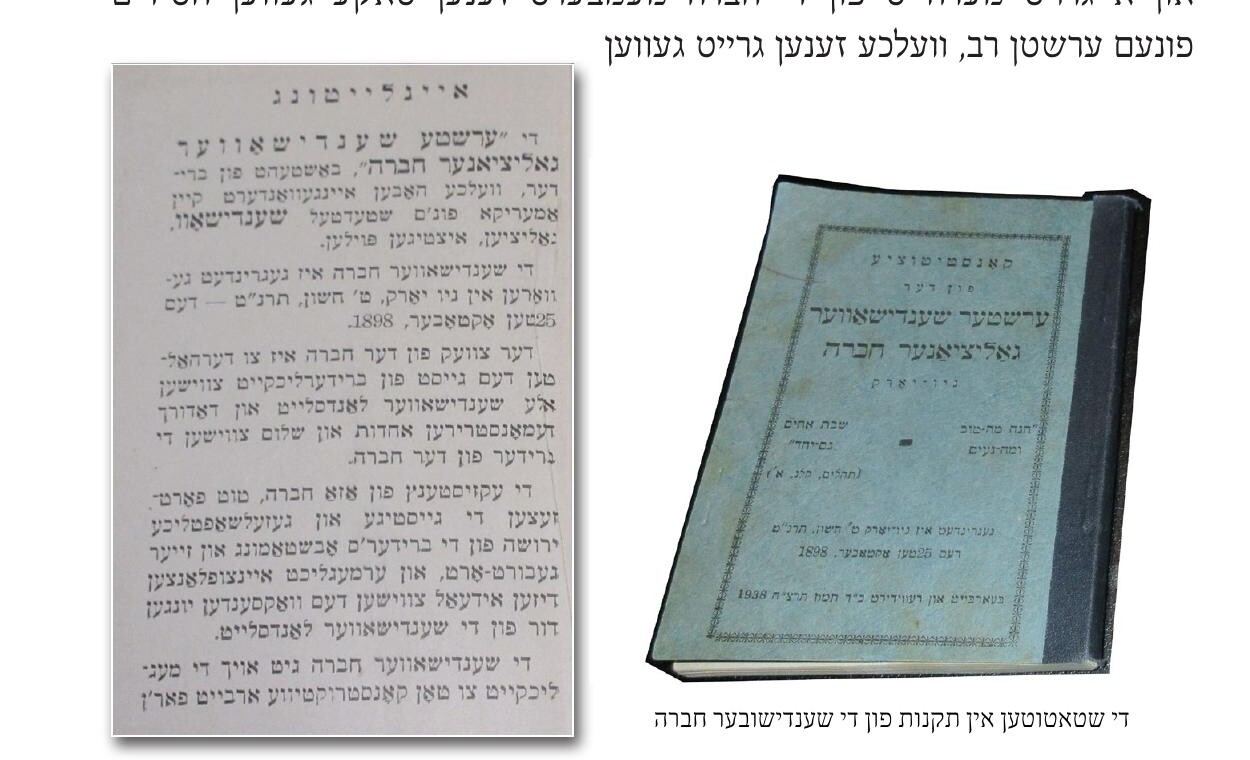
In 5659 (1899), Jews from Shendishov founded the First Shendishover Galician Society. Yisod Tzaddik states that its founders and a large majority of its members were Chassidim of Rabbi Avraham. Its membership reached into the high hundreds; its statutes required members living nearby to join the Shabbos tefillos and established a yearly yahrzeit seudah for Rabbi Avraham after his passing.
The surviving constitution and statutes turn attachment into documentary evidence. They show a beis medrash, binding communal obligations, burial societies in Queens and later New Jersey, annual remembrance, officers, and a structure that existed before Rabbi Tuvia’s first voyage.
The ציבור that received the Rebbe
When news spread that Rabbi Tuvia would come to America, the publication describes devoted Chassidim and close followers organizing the journey and a large ציבור receiving him at the harbor with song and dancing. His visits in 1923, 1925–1926, and 1928–1929 gave an already rooted attachment a living center.
Before returning to Poland in 1929, Rabbi Tuvia placed the beis medrash and ציבור in the hands of his son, Rabbi Yisroel Dovid. The American court was thus not a detached later institution: it grew from families sent and blessed by the first Rebbe, Chassidim personally attached to Rabbi Tuvia, and a direct act of continuation entrusted to the next generation.