מסע אהבת איתן · שבט תש״פ
A journey that made inherited places living again
The illustrated Masa Ahavas Eisan booklet records a carefully ordered journey through Shendishov and the sacred places of Galicia and Poland—joining tefillah and attachment to the earlier generations with preservation and shared experience.
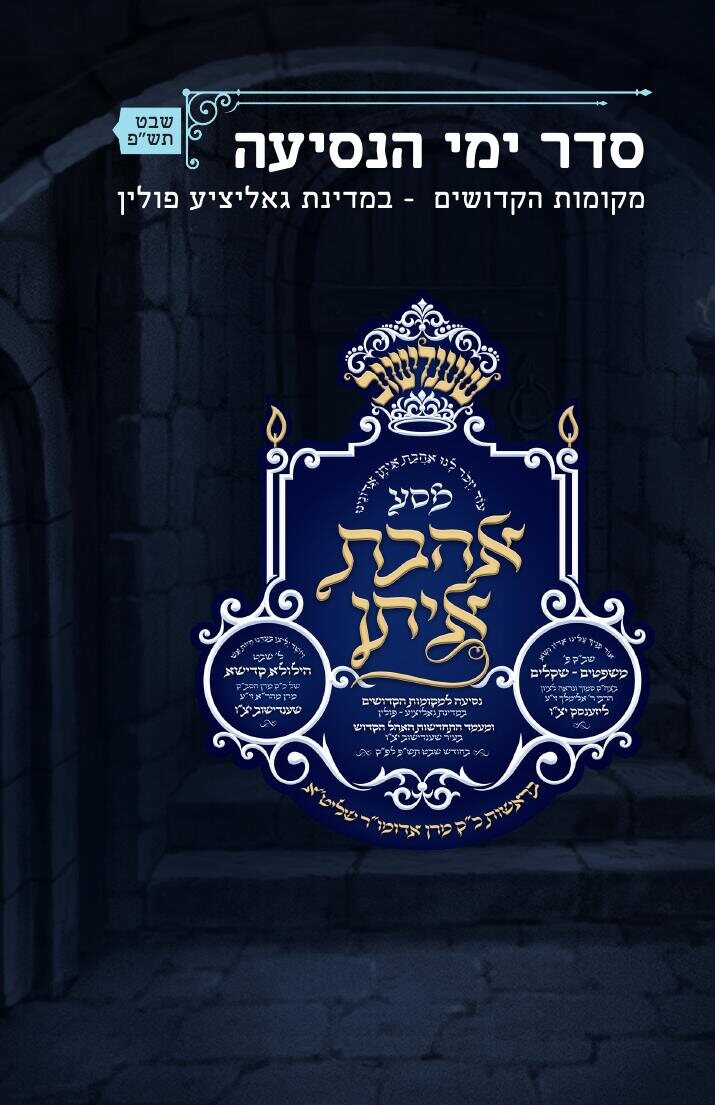
Shendishov within a wider sacred geography
The itinerary places Shendishov within a route that includes Ropshitz, Melitz, Leżajsk, Lublin, Kozhnitz, Kraków, Sanz, Łańcut, Auschwitz, Warsaw, and other places. Each stop is entered through the tzaddik, Torah, family relationship, or chapter of Jewish memory attached to it.
For Shendishov, the journey gives particular weight to the cemetery, ohel, town, and continuing responsibility for the site. The historic place becomes part of the present court’s avodah rather than a distant memorial.
A ציבור prepared for the journey
The booklet preserves a detailed order of travel, tefillos, lodging, transport, Shabbos, times, and practical preparation. Those details reveal the communal work behind the experience: a group was being brought into a shared encounter with its inherited world.
Knowing where one is going, whose resting place stands there, and what part of the chain it represents gives the tefillah its context.
From journey to preservation
The journey belongs to the later work of physical recovery: improving access, restoring the ohel and cemetery, marking the mass grave, and creating a place able to receive mispallelim. The printed record allows each later stage to be measured against what was known and possible in 5780.
A visual record of continuity
Maps, designed route pages, photographs, names of places, and the court’s own language turn the booklet into more than a schedule. It is evidence of how the present Rebbe and the ציבור understood the journey: a movement from today toward the earlier generations, and back into responsibility today.